
Best Flexible Seating Options for Middle School Classrooms
My 7th graders stopped asking to go to the bathroom every 10 minutes once I gave them permission to move.

Middle schoolers are trapped in bodies that won’t stop growing and brains that won’t stop wandering. Forcing them into rigid plastic chairs for seven hours is a recipe for chaos.
Flexible seating isn’t about beanbags and “chill vibes.” It’s about giving 12-year-olds a legal way to fidget so they can actually focus.
But here’s the catch: middle school flexible seating has to survive middle schoolers. That rules out a lot of the cute elementary stuff.
These are the options that actually hold up.
Quick Picks
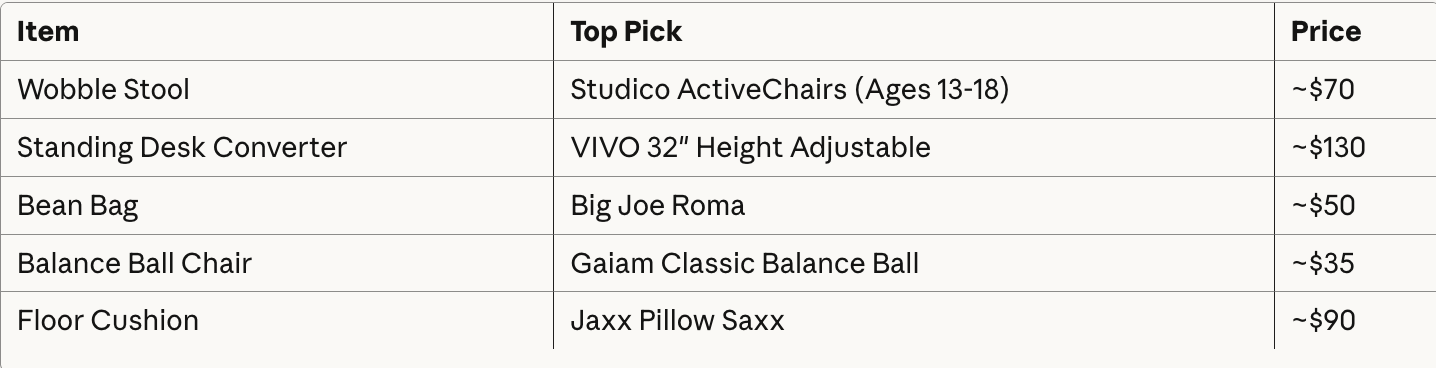
The Ratings
1. Studico ActiveChairs Adjustable Wobble Stool (~$70)
The wobble stool that can handle teenagers. Adjusts from 16.65” to 23.75”—tall enough for your 6-foot 8th grader who grew three inches over summer.
Pros: 275 lb weight limit, cushioned seat, non-slip rubberized base, actually sized for teens Cons: Takes a day or two to get used to; some students find it tiring at first
Why it works for middle school: The constant micro-movements give fidgety kids an outlet without them leaving their seat. One teacher reported her emotional-support students haven’t needed a single break since switching to wobble seating.
Verdict: ⭐⭐⭐⭐⭐ - The best wobble stool for middle school. Period.
2. VIVO 32” Standing Desk Converter (~$130)
Not every kid wants to sit. Some do their best thinking on their feet—literally. This converter sits on top of existing desks and adjusts for sitting or standing.
Pros: No assembly, fits on standard desks, two-tier design for laptop + notebook, adjusts smoothly Cons: Takes up desk real estate; works best as a station rather than assigned seating
Pro tip: Set up 2-3 standing stations around your room. Rotate access as a privilege or let students self-select.
Verdict: ⭐⭐⭐⭐ - Great option for a few spots in your room, not a full-class solution.
3. Big Joe Roma Bean Bag Chair (~$50)
Every other bean bag I bought for my classroom got destroyed within a semester. The Big Joe is still going strong three years later.
Pros: Double-stitched, stain-resistant SmartMax fabric, refillable, actually comfortable for bigger kids Cons: Takes up floor space; kids will fight over it
Real teacher review: “Knock on wood, but I would have to say it’s nearly indestructible. My students are constantly asking if they can sit on Big Joe.”
Verdict: ⭐⭐⭐⭐½ - The only bean bag I trust with middle schoolers.
4. Gaiam Classic Balance Ball Chair (~$35)
A stability ball in a frame so it doesn’t roll away. Engages core muscles and lets students bounce slightly while working.
Pros: Affordable, removable ball (doubles as exercise equipment), supportive back rest Cons: Ball needs occasional re-inflating; some students find it distracting at first
Who it’s for: Students who need constant movement but can handle the responsibility. Not ideal for your most impulsive kids.
Verdict: ⭐⭐⭐⭐ - Solid option, but requires the right student.
5. Jaxx Pillow Saxx Floor Cushion (~$90)
For reading corners or independent work time. More structured than a bean bag, but still gives that “not a desk” energy middle schoolers crave.
Pros: Machine-washable cover, holds shape, works for lounging or sitting upright Cons: Pricey for a floor pillow; you’ll want 3-4 to make it worthwhile
Verdict: ⭐⭐⭐⭐ - Best for a dedicated flexible seating zone, not scattered around the room.
Implementation Tips
Flexible seating can become chaos without structure. Here’s what works:
Start in rows. Students begin each period in assigned seats. Earn flexible seating after direct instruction.
Rotate access. Not everyone gets the wobble stool every day. Build in a fair system.
Practice transitions. Do “Desk Olympics”—race the clock to rearrange furniture quietly.
Pull privileges temporarily, not permanently. When a student abuses a seating option, they lose it for a day—not forever.
Your Turn
What flexible seating has survived your middle schoolers? Drop it in the comments - we’ll rate it.
RatedEd rates the products, PD, and programs educators actually use… so you stop wasting money on stuff that doesn’t work.