
Teaching Strategies That Actually Work, Rated
Try them. Look into the idea further. Rated for you.

Every PD session promises the same thing: strategies that will “transform your classroom.” And then you try them. And they work for about six minutes. Or they require seventeen hours of prep. Or they were designed for a class of twelve students who all want to be there.
So we did the research.
We’re rating the strategies that actually hold up in real classrooms with real kids who would rather be on their phones.
Plus: linked resources if you want to go deeper.
No sponsors. Just the stuff that’s worth your time.
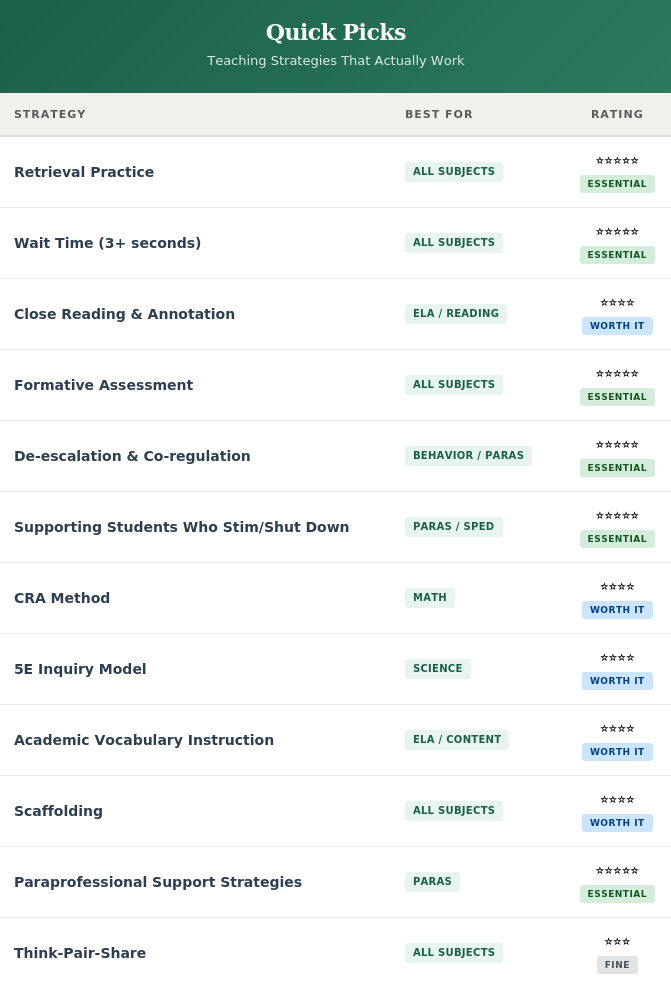
The Ratings
Retrieval Practice: ⭐⭐⭐⭐⭐ Essential
Stop re-teaching. Start retrieving.
The research is overwhelming: when students pull information out of their brains (instead of passively reviewing it), they remember it longer. Low-stakes quizzes, brain dumps, “write everything you remember” prompts. It works in every subject, at every level.
Best for: All subjects, especially content-heavy courses Works in: Junior high, high school The research: Students who use retrieval practice outperform those who re-read or highlight. Consistently.
Go deeper: Powerful Teaching by Pooja Agarwal
Paraprofessional Support Strategies:
⭐⭐⭐⭐⭐ Essential
Paras are often handed students with the most complex needs and the least amount of training. This matters.
The best resource we’ve found addresses everything: how to fade support, how to build independence, how to collaborate without overstepping.
Best for: Paraprofessionals in inclusive classrooms Works in: All levels
Go deeper: The Para Quick-Start Confidence Kit (Free Download)
Wait Time (3+ Seconds): ⭐⭐⭐⭐⭐ Essential
Ask a question. Count to three. In your head. Slowly.
That’s it. That’s the strategy.
Most teachers wait less than one second before calling on someone or rephrasing. When you push to three seconds or more, participation increases, answers get longer, and the “I don’t know” responses drop significantly.
Best for: All subjects, especially discussion-heavy classes
Works in: Elementary through high school
The research: Mary Budd Rowe’s original studies found 300-700% increases in response length.
Go deeper: Quality Questioning by Jackie Walsh
Close Reading & Annotation: ⭐⭐⭐⭐ Worth It
Teaching kids to actually read. Like, really read. Multiple passes. Annotation. Text-dependent questions.
It’s not flashy. It’s not new. But in a world where students skim everything, close reading builds the muscle for deep comprehension.
Best for: ELA, Social Studies, any text-heavy content
Works in: Junior high, high school
Caveat: Requires explicit instruction. Don’t just hand them highlighters and hope.
Go deeper: Rigorous Reading by Fisher & Frey
Formative Assessment: ⭐⭐⭐⭐⭐ Essential
Exit tickets. Thumbs up/down. Whiteboards. Quick writes.
Formative assessment isn’t a test. It’s information. It tells you, in real time, whether students are getting it or faking it. And it lets you adjust before the summative train wreck.
Best for: All subjects
Works in: All levels
The research: Dylan Wiliam’s work shows formative assessment can nearly double the rate of student learning when done consistently.
Go deeper: Embedded Formative Assessment by Dylan Wiliam
De-escalation & Co-regulation: ⭐⭐⭐⭐⭐ Essential
When a student is escalating, your calm is the intervention.
This isn’t about compliance. It’s about brain states. A dysregulated adult cannot regulate a dysregulated child. The science is clear: connection before correction.
Best for: Behavior support, crisis moments
Works in: All levels, especially junior high
Key shift: Stop trying to manage the behavior. Start trying to regulate the nervous system.
Go deeper: Connections Over Compliance by Lori Desautels
Supporting Students Who Stim, Shut Down, or Draw Instead of Work: ⭐⭐⭐⭐⭐ Essential
This one’s for the paras. The ones in the cafeteria with 100+ kids. The ones next to the student who won’t make eye contact. The ones who don’t get a script for what’s happening.
Real strategies for real moments. Print it. Keep it close.
Best for: Paraprofessionals, SpEd support
Works in: Elementary, junior high
Go deeper: Free download: Beyond “Stop That”: A Para’s Pocket Guide
CRA Method (Concrete-Representational-Abstract): ⭐⭐⭐⭐ Worth It
Start with manipulatives. Move to drawings. Then symbols.
Math teachers have known this works for decades, but secondary teachers often skip straight to abstract because “they should know this by now.” They don’t. CRA bridges the gap.
Best for: Math, especially struggling learners
Works in: Junior high, can extend to high school
Caveat: Takes longer. Worth it.
5E Inquiry Model: ⭐⭐⭐⭐ Worth It
Engage. Explore. Explain. Elaborate. Evaluate.
The 5E model structures science instruction around inquiry, not lecture. Students investigate before you explain. It flips the traditional “I’ll tell you, then you’ll confirm” model.
Best for: Science
Works in: Junior high, high school
Caveat: Requires letting go of some control. Hard for some of us.
Go deeper: The BSCS 5E Instructional Model by Rodger Bybee
Academic Vocabulary Instruction: ⭐⭐⭐⭐ Worth It
Students can’t access content they can’t decode. And academic vocabulary (the words we assume they know) is often the barrier.
Marzano’s six-step process works: provide a description, let students restate, create a visual, discuss, refine, and play with the terms through games.
Best for: ELA, content areas with heavy terminology
Works in: Junior high, high school
Go deeper: Building Academic Vocabulary by Marzano
Scaffolding: ⭐⭐⭐⭐ Worth It
Breaking learning into chunks. Providing temporary supports. Gradually releasing responsibility.
It’s not lowering expectations. It’s building the ladder to reach them.
Best for: All subjects, especially with struggling learners
Works in: All levels
Key: The supports are temporary. You’re building independence, not dependence.
Think-Pair-Share: ⭐⭐⭐ Fine
Yes, it works. Yes, it increases participation. Yes, you should use it.
But let’s be honest: by junior high, kids know the drill. It can feel stale if you’re not intentional about the pairing and the sharing components. Works better in elementary. Still useful in secondary, just not transformative.
Best for: All subjects
Works in: Elementary (better), junior high/high school (fine)
How We Rated
We looked at three things:
Research backing: Is there evidence this works, or is it just popular?
Classroom reality: Does it hold up with 30+ kids, limited time, and zero extra resources?
Teacher sustainability: Can you actually do this without burning out?
Strategies that scored high on all three got Essential. Strategies that require more investment but pay off got Worth It. Strategies that work but aren’t game-changers got Fine.
Take Action!
You don’t need more strategies. You need the right ones.
These twelve aren’t trendy. They’re not new. But they’re backed by research, tested in real classrooms, and sustainable over time.
Pick one you’re not using well and share in the comments to lock it in.
I appreciate the honesty here. So much PD feels aspirational but collapses under the weight of a real timetable and 30+ students.
What stands out is that your “Essential” list isn’t flashy — it’s foundational. Retrieval, wait time, formative assessment, regulation. These are low-cost, high-impact habits that compound over time. They’re less about transforming a classroom overnight and more about strengthening it daily.
Yay for close reading and annotating! Yay for all of these, actually :)